 Dr. Akun Liang (College of Science, Eastern Institute of Technology, Ningbo, China) is awarded the 2026 EHPRG Award in recognition of his pioneering contributions to understanding the high-pressure behavior of metal iodates, establishing structure–property relationships and general principles for bandgap engineering, and to the high-pressure high-temperature synthesis of novel transition-metal nitrides and carbonitrides, revealing chemical reactions accessible only under such extreme conditions.
Akun Liang will deliver the EHPRG Award lecture on Wednesday 26 August 2026 in Palavas-les-Flots (France).
Single-crystal X-ray diffraction under high pressure
Accurate determination of the crystallographic structure of materials under high pressure is of fundamental importance, both for understanding pressure-induced physical phenomena and for guiding the synthesis of novel compounds that are inaccessible at ambient conditions. Single-crystal X-ray diffraction (SCXRD) remains one of the few in-situ probes capable of delivering this level of structural accuracy inside the diamond anvil cell (DAC).
In this talk, I will present the single-crystal X-ray diffraction method under high pressure and illustrate its application in two complementary contexts. The first concerns single crystals that are already obtainable at ambient conditions, a few micrometres in size, and loaded directly into the DAC. Using examples from MAPbBr3, Ba(IO3)2·H2O, B13C2, and Cd(IO3)2, I will show how high-pressure SCXRD, performed up to megabar pressures, resolves subtle structural changes that have been misassigned or overlooked by other in-situ probes.
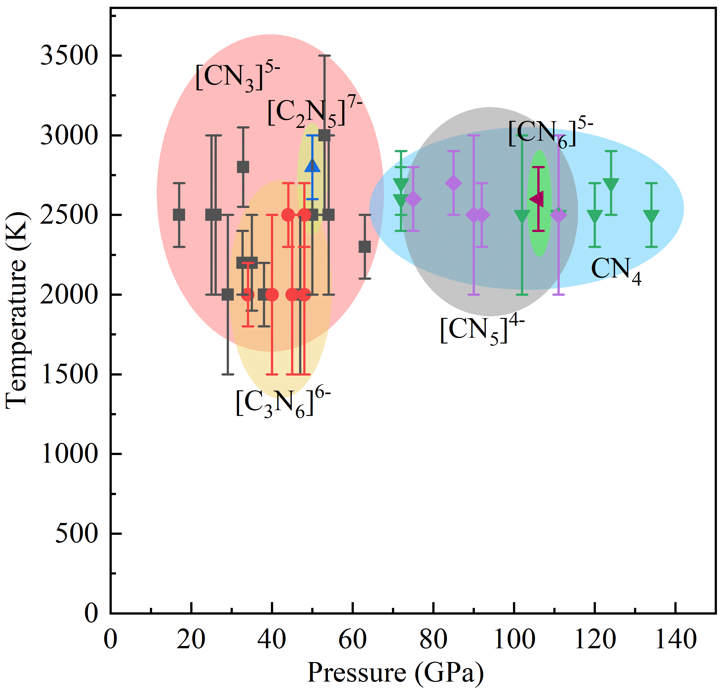 The second concerns a newer approach: SCXRD performed directly on polycrystalline samples synthesized in a laser-heated diamond anvil cell, wthout the need to load a pre-formed single crystal. I will discuss how this method has enabled the discovery of an emerging family of metal carbonitrides, including the guanidinate anion [CN3]5− [1], its corner-sharing polymerized form [2], the fully deprotonated melaminate anion [C3N6]6−, and previously unknown CN4-based anions in which an additional nitrogen atom is appended to a terminal N of the tetrahedron, extending the stoichiometry to [CN5]4− and [CN6]5− polycarbonitride species [3].
Together, these results demonstrate that high-pressure single-crystal X-ray diffraction, whether applied to pre-existing single crystals or directly to the products of in-situ high-pressure synthesis, is a uniquely powerful tool, it reveals structural details invisible to other techniques, and it opens a route to entirely new classes of compounds that do not exist at ambient conditions.
References:
[1] A. Aslandukov et al., Angew. Chem. Int. Ed. 62, 2023, e202311516
[2] L. Brüning et al., Angew. Chem. Int. Ed. 62, 2023, e202311519
[3] F. I. Akbar et al., J. Am. Chem. Soc. 148, 2026, 11915-11924
For any question, please contact the